
Frankfurt (Germany), 2 Oct. (LaPresse) – A Russian national with alleged links to the GRU, Moscow’s military intelligence service, has been identified as the suspected coordinator of the failed attack involving a drone laden with explosives at Leipzig/Halle Airport. This is according to a joint investigation by *Welt am Sonntag* and *The Telegraph*, based on confidential documents from the intelligence services of Germany, Lithuania and Poland, and on interviews with senior Western intelligence officials. The suspect is Oleg Lewuschkin, a Russian national who is believed to have links to Denis Smoljaninow, identified as one of the organisers of Russian sabotage operations in Europe. According to German investigators, Lewuschkin is believed to have travelled to Germany to prepare the operation and subsequently instructed the Belarusian national Andrei Karschakou to carry it out. On 31 July, Lewuschkin is said to have carried out a reconnaissance mission at Leipzig/Halle Airport, a major logistics hub also used for supplies to Ukraine. Five days later, a drone loaded with explosives struck the wing of a Ukrainian Antonov An-124 parked at the airport, before falling onto the runway without exploding. The aircraft was carrying around 25,000 litres of kerosene. Investigators believe that 1.8 kilograms of Semtex, a powerful plastic explosive, had been smuggled into Germany via Bulgaria and Serbia for the operation. Traces of DNA linked to Karschakou were also found on a fragment of a glove near a makeshift antenna which, according to investigators, was used to control the drones. Security agencies have linked the attack to a wider sabotage campaign attributed to special units of the GRU in Europe. According to a senior German intelligence official quoted in the investigation, Germany has increasingly become an “operational theatre” for the Russian services: “What were once isolated cases, we are now seeing on a large scale.” The Russian embassy in Berlin has rejected the allegations, denouncing a “new wave of anti-Russian hysteria in Europe” and describing the claims as “baseless”.
Germany: media report suspect identified as coordinator of drone attack in Leipzig
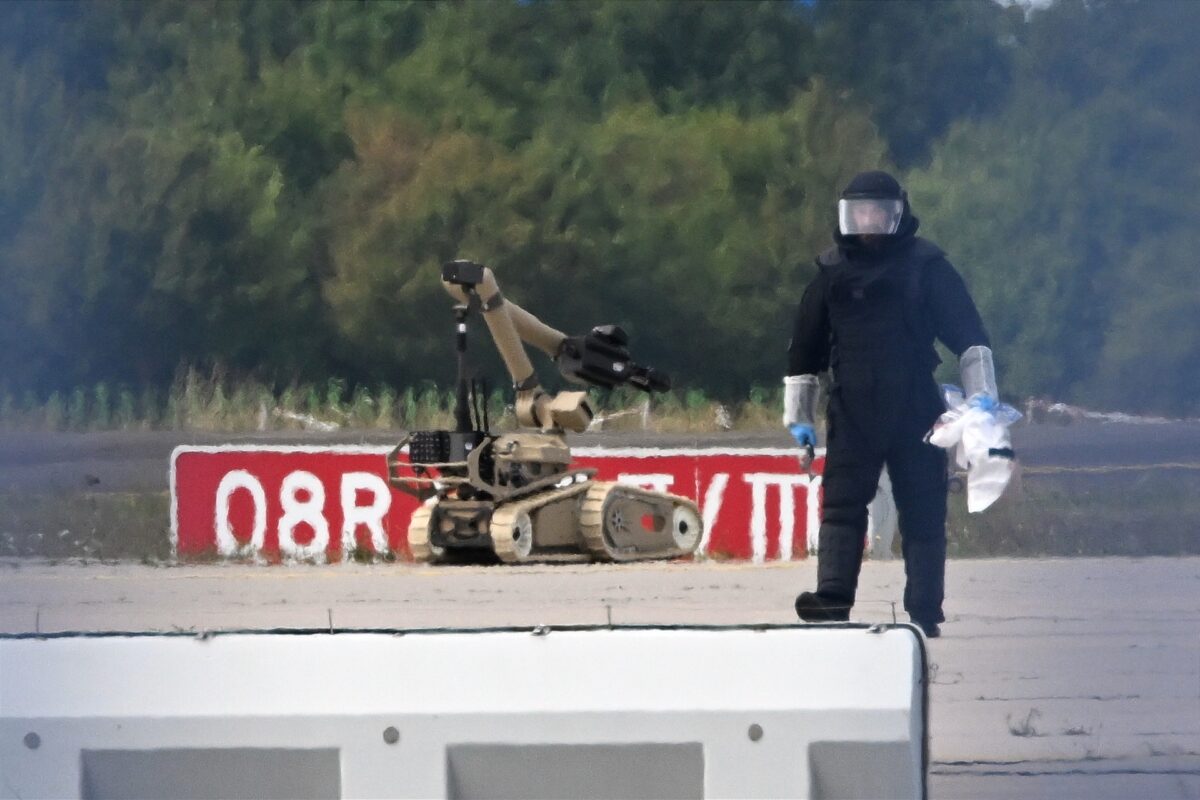

Frankfurt (Germany), 2 Oct. (LaPresse) – A Russian national with alleged links to the GRU, Moscow’s military intelligence service, has been identified as the suspected coordinator of the failed attack involving a drone laden with explosives at Leipzig/Halle Airport. This is according to a joint investigation by *Welt am Sonntag* and *The Telegraph*, based on confidential documents from the intelligence services of Germany, Lithuania and Poland, and on interviews with senior Western intelligence officials. The suspect is Oleg Lewuschkin, a Russian national who is believed to have links to Denis Smoljaninow, identified as one of the organisers of Russian sabotage operations in Europe. According to German investigators, Lewuschkin is believed to have travelled to Germany to prepare the operation and subsequently instructed the Belarusian national Andrei Karschakou to carry it out. On 31 July, Lewuschkin is said to have carried out a reconnaissance mission at Leipzig/Halle Airport, a major logistics hub also used for supplies to Ukraine. Five days later, a drone loaded with explosives struck the wing of a Ukrainian Antonov An-124 parked at the airport, before falling onto the runway without exploding. The aircraft was carrying around 25,000 litres of kerosene. Investigators believe that 1.8 kilograms of Semtex, a powerful plastic explosive, had been smuggled into Germany via Bulgaria and Serbia for the operation. Traces of DNA linked to Karschakou were also found on a fragment of a glove near a makeshift antenna which, according to investigators, was used to control the drones. Security agencies have linked the attack to a wider sabotage campaign attributed to special units of the GRU in Europe. According to a senior German intelligence official quoted in the investigation, Germany has increasingly become an “operational theatre” for the Russian services: “What were once isolated cases, we are now seeing on a large scale.” The Russian embassy in Berlin has rejected the allegations, denouncing a “new wave of anti-Russian hysteria in Europe” and describing the claims as “baseless”.