
Frankfurt (Germany), 26 August (LaPresse) – Six employees at Frankfurt Airport have contracted malaria, probably as a result of an infected mosquito that arrived on board a flight from an area where the disease is widespread. One of the infected workers has died. This has been confirmed by the airport operator Fraport and the Robert Koch Institute (RKI), as reported by the German media. “We can unfortunately confirm this. Our deepest condolences go to the family of the deceased,” said a Fraport spokesperson. The death concerns one of the employees who had contracted the infection whilst carrying out their work duties. The total number of cases has risen to six after Fraport reported four infected employees in mid-July. According to the available information, the cause is believed to be imported infected mosquitoes, which may have arrived at the airport in July, for example in the hold of an aircraft arriving from a malaria-risk area. All the other infected employees are currently receiving medical treatment. Mosquito traps have been installed at the airport and a number of specimens have been captured. The insects will now be analysed in a laboratory to check for the presence of the parasite responsible for malaria. Fraport has also advised its employees to seek medical attention if they experience typical symptoms of malaria, whilst noting that they work at the airport. An information notice has also been sent to all holders of an airport access pass. According to the RKI, in July and August, cases of malaria were reported exclusively in the Rhine-Main region, the onset of which is ‘probably linked to work at Frankfurt Airport’. The institute has informed doctors in the region about the recorded cases. Frankfurt’s Department of Public Health has described so-called ‘airport malaria’ as a very rare mode of transmission of the disease outside endemic areas. “Person-to-person transmission plays no role in ‘Airport Malaria’,” a spokesperson emphasised. According to the RKI, this rare form of malaria occurs when an infected mosquito is accidentally carried on board an aeroplane or inside luggage. Transmission can therefore take place on the aeroplane, at the airport or in the immediate vicinity of the airport.
Germany: Malaria at Frankfurt Airport; one person has died amongst the six infected
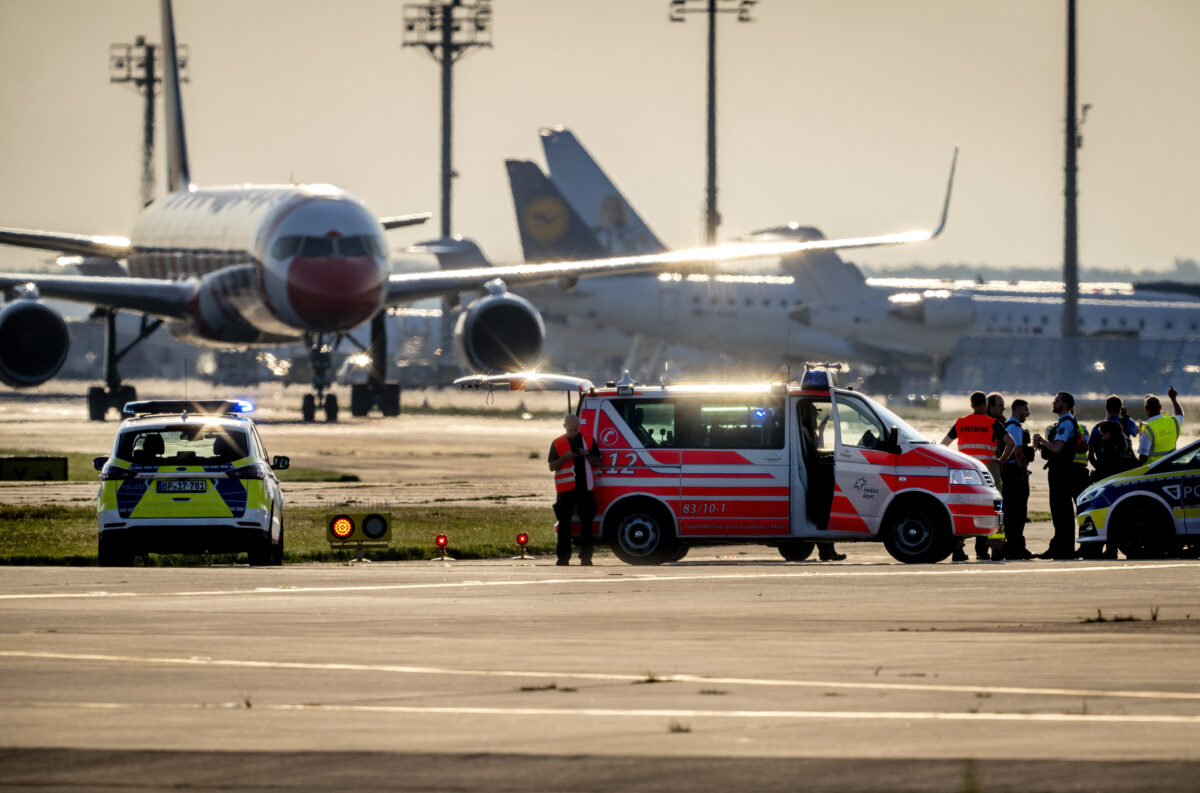

Frankfurt (Germany), 26 August (LaPresse) – Six employees at Frankfurt Airport have contracted malaria, probably as a result of an infected mosquito that arrived on board a flight from an area where the disease is widespread. One of the infected workers has died. This has been confirmed by the airport operator Fraport and the Robert Koch Institute (RKI), as reported by the German media. “We can unfortunately confirm this. Our deepest condolences go to the family of the deceased,” said a Fraport spokesperson. The death concerns one of the employees who had contracted the infection whilst carrying out their work duties. The total number of cases has risen to six after Fraport reported four infected employees in mid-July. According to the available information, the cause is believed to be imported infected mosquitoes, which may have arrived at the airport in July, for example in the hold of an aircraft arriving from a malaria-risk area. All the other infected employees are currently receiving medical treatment. Mosquito traps have been installed at the airport and a number of specimens have been captured. The insects will now be analysed in a laboratory to check for the presence of the parasite responsible for malaria. Fraport has also advised its employees to seek medical attention if they experience typical symptoms of malaria, whilst noting that they work at the airport. An information notice has also been sent to all holders of an airport access pass. According to the RKI, in July and August, cases of malaria were reported exclusively in the Rhine-Main region, the onset of which is ‘probably linked to work at Frankfurt Airport’. The institute has informed doctors in the region about the recorded cases. Frankfurt’s Department of Public Health has described so-called ‘airport malaria’ as a very rare mode of transmission of the disease outside endemic areas. “Person-to-person transmission plays no role in ‘Airport Malaria’,” a spokesperson emphasised. According to the RKI, this rare form of malaria occurs when an infected mosquito is accidentally carried on board an aeroplane or inside luggage. Transmission can therefore take place on the aeroplane, at the airport or in the immediate vicinity of the airport.